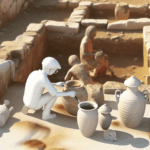

Here’s what you need to know about Carthage’s child sacrifice debate: for centuries, Greek and Roman writers claimed Carthaginians sacrificed children to gods like Baal Hammon and Tanit. Modern archaeology complicated that story, especially after excavations of tophets—open-air sanctuaries containing urns with cremated remains. Today, new methods and renewed scrutiny have reopened the question: evidence of ritual killing, or a cemetery for infants who died naturally?
Chapter 1: The Basics—What Sources Say and Why They Matter
Carthage, founded by Phoenician settlers and later a major Mediterranean power, left limited indigenous written records. That scarcity makes outsiders’ accounts unusually influential—especially those from rival societies that fought Carthage.
Several Greco-Roman authors described child sacrifice in Punic contexts. These include claims (in varying detail) that children were offered in times of crisis, sometimes connected with elite families, and that the rites involved burning. Yet historians treat these texts cautiously for two main reasons:
- Bias and propaganda: Rome fought three Punic Wars against Carthage, culminating in Carthage’s destruction in 146 BCE. Hostile narratives could serve moral and political purposes.
- Distance from events: Some accounts are late, secondhand, or written far from North Africa, raising questions about accuracy and transmission.
Still, it would be a mistake to dismiss every testimony automatically. Ancient authors sometimes preserved real practices (or rumors rooted in real practices), and their descriptions became testable once archaeological evidence entered the discussion.
Chapter 2: The Tophet Evidence—Urns, Inscriptions, and Competing Readings
The modern debate centers on archaeological sites called tophets, known from Carthage and other Phoenician-Punic settlements in the western Mediterranean. These precincts typically contain:
- Large numbers of urns filled with cremated bone fragments, often from very young children and sometimes animals
- Stelae and inscriptions that appear to record vows or dedications to deities commonly identified as Baal Hammon and Tanit
- Ritualized layout suggesting repeated ceremonial activity over long periods
Interpretations diverge sharply:
- Sacrifice interpretation: The tophet is seen as a sacred space where children were ritually killed and offered, with animal remains reflecting substitute offerings in some cases. Inscriptions are read as thank-offerings connected to fulfilled vows.
- Infant cemetery interpretation: The tophet is framed as a specialized burial ground for infants who died naturally (in a world with extremely high infant mortality), with cremation as the standard mortuary practice for this group. Inscriptions are understood as commemorative religious dedications rather than proof of killing.
Why is it difficult to settle? Cremated remains can be hard to assess for cause of death, and infant bone development stages are challenging to estimate precisely after burning. Even when age-at-death is clearer, it does not automatically reveal whether death was natural or deliberate.
Chapter 3: Why the Debate Reopens—New Methods, Same Hard Question
In recent years, scholars have revisited older conclusions using improved archaeological recording, refined osteological approaches, and broader comparative context. The reopening is less about a single “smoking gun” and more about how multiple lines of evidence are weighed.
Key issues that keep the discussion active include:
- Demography and age profiles: Do the age distributions match what we would expect from natural infant mortality alone, or do they cluster in ways that suggest selection? Different studies have reached different conclusions, partly due to sampling choices and preservation limits.
- Ritual setting vs. cemetery function: The tophet’s formal religious character is clear, but religious settings can host both funerary rites and sacrificial rites. Determining which is primary is the challenge.
- Animal remains: Animals in urns can be read as substitute sacrifices, companion offerings, or part of a broader ritual grammar that does not require child killing. Context and frequency matter, and patterns vary by site and period.
- Comparisons across the Punic world: Similar tophet-like precincts exist beyond Carthage, and regional differences complicate any single explanation. A practice could also change over time—intensifying, fading, or being reinterpreted.
Most responsible summaries today avoid absolute certainty. Some researchers argue the total pattern still points toward at least occasional sacrifice; others contend the evidence better fits a sacredized infant burial tradition. The debate reopens because the evidence is substantial, emotionally charged, and genuinely ambiguous in places—exactly the kind of historical problem that resists simple answers.
Conclusion: The reopened debate over Carthage and child sacrifice reflects a wider lesson in ancient history: texts, archaeology, and scientific analysis rarely align perfectly. Classical authors provide accusations; tophets provide material culture; modern methods refine what can be inferred from remains and context. The key takeaway is balance—Carthage’s tophets are undeniably ritual spaces, but whether they document systematic sacrifice, selective sacrifice, or sacred infant burial remains an active scholarly question.