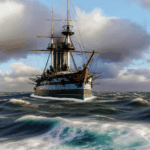

In the gray churn of the North Sea, the line between engineering triumph and catastrophe could be a heartbeat. On the morning of June 2, 1891, aboard Britain’s newest battleship, the air filled with cordite smoke and shouted orders. Then, as the big guns fired, the ship seemed to betray itself. Within minutes, HMS Victoria would be dying—not from enemy fire, but from her own design and decisions.
Chapter 1: A Flagship Built for Power—and a Navy Built for Certainty
HMS Victoria entered service in 1890 as an emblem of late-Victorian confidence: a modern battleship, thickly armored, bristling with heavy artillery, and designed to take punishment. She carried two massive 16.25-inch (413 mm) breech-loading guns in a single forward turret—among the largest weapons ever mounted on a Royal Navy ship of her era.
But the era’s battleship design came with compromises. Weight distribution, armor protection, and internal subdivision were constant balancing acts. Naval architects were still learning, often painfully, how new materials, higher muzzle energies, and complex mechanical systems behaved at sea. A flagship like Victoria wasn’t just a warship; it was a floating statement that the Royal Navy’s doctrine and technology were sound.
In that culture, orders were expected to be executed crisply, and formations were expected to hold. The fleet drilled for precision, because the theory of battle demanded it: lines of ironclads turning and maneuvering together, guns speaking in controlled salvos. Yet the sea does not forgive rigid certainty—and neither do steel hulls when asked to do the impossible.
Chapter 2: The Turn That Broke the Fleet
On June 22, 1893, Victoria led the Mediterranean Fleet off Tripoli, Lebanon, under Vice-Admiral Sir George Tryon. The fleet was steaming in two parallel columns. Tryon ordered both columns to turn inward simultaneously—an evolution that, given the spacing, left insufficient room for the ships to swing without colliding.
Officers questioned the order. Signals were checked and rechecked. The geometry was wrong. But the order stood, and in an age that prized obedience as a naval virtue, ships began their turns.
What followed was stark and physical: HMS Camperdown, turning in the opposite column, struck Victoria on her starboard side. The collision opened a deep gash near the bow. It was not an explosion, not enemy action, but the blunt force of one battleship’s reinforced prow biting into another’s hull.
The ship’s fate was decided quickly by water, physics, and the limits of damage control. As seawater poured in, Victoria developed a heavy list. Some watertight doors and hatches were reportedly open—whether for ventilation, routine movement, or operational convenience—reducing the ship’s ability to contain flooding. The list became a capsize, and within roughly thirteen minutes of the collision, the flagship rolled and sank. Over 350 men died, including Admiral Tryon.
It was a disaster born of command decisions, human factors, and the unforgiving mathematics of formation maneuvering. But it also became the stage for another, quieter lesson—one written in the ship’s armament and her final moments.
Chapter 3: “Fired Itself Apart”—Recoil, Structural Strain, and the Myth with a Real Core
The phrase “the warship that fired itself apart” echoes through naval lore because it captures a fear that was very real in the late 19th century: that weapons had become so powerful they threatened their own platforms. In Victoria’s case, the dramatic sinking was caused by collision, not by gunfire. Yet the legend persists because it has a technical foundation.
Those 16.25-inch guns were notorious for their slow rate of fire and severe stresses. Contemporary accounts and later historical analyses describe how extremely large-caliber guns of that generation could suffer from wear, cracking risks, and intense recoil forces that challenged mountings and ship structure. The recoil of heavy naval artillery is not merely a backward shove; it is a violent transfer of momentum into the turret, the barbette, the supporting decks, and the hull framing. If design margins are thin, repeated firing can loosen fittings, distort structures, and accelerate fatigue.
For ships across multiple navies in that era, “too much gun” was a known danger in practice if not always admitted in brochures and speeches. Even when catastrophic self-destruction did not occur, damage from firing—cracked brackets, shifted supports, misaligned machinery, and degraded accuracy—could still erode combat effectiveness. In that sense, the idea of a ship “firing itself apart” reflects an authentic anxiety: the race for bigger guns was outrunning the ability to absorb their forces elegantly.
With Victoria, the more immediate “self-inflicted” element lay in doctrine and command culture rather than metallurgy. Still, the ship’s story sits at the intersection of two late-Victorian pressures: increasing weapon power and an operational mindset that assumed perfect control. When either assumption failed, the consequences were abrupt.
In the end, HMS Victoria did not die to her own muzzle blast, but she remains a warning about how warships can be undone by the systems meant to make them formidable—whether those systems are guns that strain hulls or commands that strain reality. The sea recorded the verdict in minutes. The legacy endures in every navy’s quiet question: what, exactly, can our machines—and our certainty—survive?