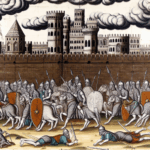

Dawn breaks over the Seven Hills, and the city that once commanded the Mediterranean holds its breath. Rome’s walls are crowded with citizens—senators, priests, laborers—listening for the sound that has haunted them for months: the shifting of foreign camps beyond the gates. In a moment that feels unthinkable for the “Eternal City,” Rome will reach not for a sword, but for its treasury.
Chapter 1: The Sack That Shook the World (410 CE)
In the early fifth century, the Western Roman Empire is still vast on maps, but brittle in practice. Civil wars, contested successions, and a shrinking tax base have drained the state’s ability to field and pay reliable armies. Along Rome’s frontiers, entire peoples are on the move—some pushed by hunger, some by opportunity, some by the knock-on pressures of larger migrations. Among them are the Visigoths, led by Alaric.
Alaric is not a stranger at the edge of Roman power; he and many of his followers have long interacted with the empire as federate troops and negotiating partners. But by 408–410 CE, the relationship collapses into siege warfare. The sources—especially later narratives such as those of Zosimus—describe a city cut off, struggling with shortages and panic. Rome’s traditional defenses—its prestige, its rituals, its memory of domination—cannot feed its people.
Faced with the growing threat of starvation and internal disorder, Roman elites attempt a strategy as old as diplomacy itself: purchase time. The city agrees to provide Alaric with an enormous ransom. Ancient accounts emphasize the weight and spectacle of the payment: gold and silver, and other valuables, stripped from households and public stores. The exact figures vary between sources, and historians treat them cautiously, but the central fact is consistent: Rome sought to avert disaster through payment.
It works—briefly. The besiegers withdraw, and Rome exhales. Yet the relief is temporary. Negotiations between Alaric and the imperial court falter again, especially amid competing power centers in Italy and the shifting fortunes of generals and emperors. The logic of ransom—pay now, talk later—cannot resolve the deeper question Alaric presses: a secure settlement, official recognition, and provisions for his people within the imperial system.
Chapter 2: Counting Out the Empire’s Wealth
Ransom is not simply “money changing hands.” In late antiquity, it is a political performance: a city publicly acknowledging that it cannot, at that moment, impose its will by force. For Rome, a place saturated with symbols of invincibility, the act carries extraordinary psychological weight.
The payment itself reflects a harsh reality. By the fifth century, coin and bullion are not merely economic tools; they are instruments of survival. Armies must be paid. Allies must be persuaded. Rivals must be managed. When fiscal systems strain, rulers and city councils turn to extraordinary measures: emergency levies, confiscations, and the conversion of precious objects into negotiable wealth.
Contemporary Christian writers, though sometimes separated from events by distance or agenda, interpret the crisis through moral and theological frameworks. Some see the humiliation as punishment for Rome’s sins; others emphasize the fragility of earthly power. Yet beneath these interpretations lies a shared observation: the empire’s old certainty is gone. Rome can still command reverence, but reverence does not stop a siege.
Even as the ransom buys a pause, it also reveals the empire’s dilemma. Payment is a short-term solution that can encourage renewed demands. If a city can be made to pay once, why not again? Meanwhile, failure to pay risks immediate catastrophe. For Rome’s leaders, the decision is less a choice between pride and shame than a calculation of which disaster they can postpone.
Chapter 3: When the Money Ran Out
The final outcome is the moment that echoes through history: in August 410 CE, Alaric’s forces enter Rome, and the city is sacked. Even then, the event is complex. The sack is real—property seized, panic spread, refugees created—but ancient reports also suggest it was not the total annihilation later imagination sometimes paints. Churches are described in some accounts as places of refuge, and the city continues to exist as a living community afterward.
Still, symbolism matters. For centuries, Rome had been the stage on which emperors, generals, and senators acted out the drama of world rule. Now it becomes a lesson in vulnerability. The earlier ransom becomes part of that lesson: evidence that Roman power had shifted from commanding outcomes to bargaining for them.
Historians today place the episode within a wider pattern. The late empire frequently used negotiation, subsidies, and settlement as tools of frontier management. Paying a group was not always a sign of weakness; sometimes it was a rational policy—cheaper than war, faster than rebuilding a shattered region. But when the state’s resources and political unity erode, the same tool can become a trap, exposing how limited the remaining options truly are.
Rome’s decision to pay off invaders was not a single act of cowardice or cleverness—it was a symptom of an empire forced into improvisation. The ransom bought time, but it could not buy stability. In the long shadow of 410, the question lingers like footsteps in an empty forum: when a superpower starts paying for peace, is it practicing diplomacy—or admitting that its age of certainty has ended?