
In the winter of the Battle of the Atlantic, the ocean was a killing ground. Convoys crept through darkness while German U-boats hunted by sound and silhouette. Britain needed air cover far beyond the reach of land-based aircraft—and it needed it fast. Out of that pressure came a proposal so strange it sounded like myth: a giant aircraft carrier made not of steel, but of ice.
Chapter 1: The Atlantic Gap and a Desperate Idea
By 1942, Allied shipping losses were severe, and one strategic problem loomed large: the “Mid-Atlantic Gap,” a stretch of ocean where aircraft from Britain, Iceland, or Newfoundland could not reliably patrol. Escort carriers were coming, but shipyards were stretched, steel was rationed, and time was measured in sinkings.
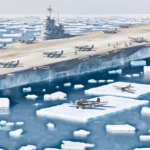
Into that crisis stepped Geoffrey Pyke, an inventive and unconventional thinker working within the orbit of Lord Louis Mountbatten’s Combined Operations. Pyke’s concept was audacious: build vast floating airfields that could loiter in the Atlantic for months, immune to torpedoes in the way a conventional hull was not. The proposal gained attention in part because it promised to trade scarce wartime resources—especially steel—for something abundant in the North Atlantic: cold.
The project took its name from the 19th-century general Sir Isaac Brock, nicknamed “Habbakuk,” a biblical reference to something astonishing and hard to believe. In wartime London, the name fit. The idea was not merely to freeze water into a ship-shaped block, but to engineer a material that behaved like a structural solid.
Chapter 2: Pykrete—Ice Reinforced for War
Plain ice cracks, creeps, and melts. But researchers discovered that mixing ice with wood pulp created a composite with surprising properties. The material—eventually dubbed pykrete—was stronger and tougher than ice alone, resisted cracking, and melted far more slowly. In controlled demonstrations, it could even stop bullets that would shatter normal ice; accounts of these tests survive in wartime anecdotes and reports, though the dramatic retellings sometimes outshine the dry engineering reality.
Still, turning a laboratory curiosity into an ocean-going warship was another matter. A pykrete carrier, as envisioned, would be enormous—large enough to operate aircraft and stable enough to serve as a mobile air base. But pykrete’s advantages came with strict requirements:
- Continuous refrigeration: To remain structurally sound, the hull would need to be kept below freezing internally, demanding large refrigeration plants and extensive insulation.
- Material logistics: The wood pulp component meant vast quantities of processed fiber, adding a different kind of wartime supply burden.
- Construction complexity: Building a massive shaped hull from frozen composite required facilities, molds, and techniques unlike standard shipbuilding.
To test feasibility, a prototype was built in Canada in 1943 on Patricia Lake in Jasper National Park, Alberta. The small craft—refrigerated internally and constructed from pykrete—demonstrated that the material could be formed into a stable floating structure and would endure through warmer seasons better than ordinary ice. But it also underscored the scale of the engineering challenge: the prototype was manageable; a full carrier would be an industrial undertaking on the level of major ship programs.
Chapter 3: Why the Ice Carrier Melted Away
Project Habbakuk did not fail because the idea was pure fantasy. It failed because the strategic and industrial landscape shifted while the concept was still finding its footing.
As 1943 turned into 1944, several developments reduced the need for a floating ice airfield. Long-range patrol aircraft—most famously the Consolidated B-24 Liberator in maritime roles—helped close the air-cover gap. Escort carriers and improved convoy tactics expanded protective reach. Radar, high-frequency direction finding, and advances in anti-submarine warfare eroded the U-boat advantage. The Atlantic was still dangerous, but the emergency that inspired Habbakuk was easing.
At the same time, the practical drawbacks remained stubborn:
- Cost and time: A full-scale pykrete vessel, once properly costed, appeared less like a cheap substitute and more like an expensive, novel megaproject.
- Power demand: The refrigeration systems would require significant energy and maintenance—competing with wartime priorities.
- Operational questions: How would repairs work? How would the ship behave under sustained attack, or in varying climates? These were answerable questions, but not quickly.
In the end, Habbakuk was set aside. The prototype on Patricia Lake was left to the seasons, gradually melting back into the water, a quiet end for a plan born of crisis.
Project Habbakuk remains one of World War II’s most revealing “what-ifs”: not a tale of madness, but of wartime improvisation pushed to its limits. It shows how strategy can bend engineering—and how engineering, in turn, can expose strategy’s hidden costs. In the cold logic of the Atlantic, an ice carrier was briefly plausible. Its legacy is a reminder: necessity sparks invention, but victory often depends on what can be built in time.