
Let’s explore Rome’s woman who “poisoned an empire”: Locusta, a notorious poisoner whose name became synonymous with lethal intrigue in the first century CE. Here’s what you need to know about who she was, how she rose to influence under imperial patronage, and why ancient sources portray her as a tool—and a symbol—of Rome’s darkest power struggles.
Chapter 1: Who Was Locusta, and Why Did Rome Remember Her?
Locusta (often called “Locusta of Gaul”) appears in Roman historical writing as a professional poisoner active during the reign of Emperor Nero (r. 54–68 CE). Our main surviving narratives come from senatorial-era authors writing decades after the events—especially Tacitus (Annals), Suetonius (Nero and Claudius), and Cassius Dio (Roman History). They are valuable but not neutral: their accounts reflect elite hostility toward Nero and a taste for moral warnings about corruption.
Even with that caution, the sources agree on several core points:
- Locusta was known for expertise in poisons and was already in trouble with the law before being drawn into imperial circles.
- She gained protection and status through the patronage of Nero and his allies.
- Her skills were linked to political deaths at the very top of Roman society, turning poisoning into an instrument of statecraft.
In Rome, poisoning carried special horror because it was intimate, hidden, and difficult to prove. It also fit Roman anxieties about household power—food, medicine, and servants—becoming channels for assassination.
Chapter 2: Poison as Politics—From Claudius to Britannicus
Locusta’s story is inseparable from the succession crises that surrounded Nero’s rise. Ancient authors connect her—directly or indirectly—to two famous deaths: Emperor Claudius (d. 54 CE) and Claudius’ son Britannicus (d. 55 CE).
Claudius and Agrippina (the contested backdrop)
Some ancient accounts claim Claudius was poisoned so Nero—Agrippina the Younger’s son—could become emperor. Tacitus and Suetonius report poisoning rumors, with details varying by author and tradition. However, modern historians emphasize that Claudius’ death cannot be verified as murder; the narrative may reflect later political storytelling and the Roman tendency to explain sudden imperial deaths as poison. Locusta is sometimes drawn into these traditions, but the evidence is less firm than in the next case.
Britannicus and the more consistent tradition
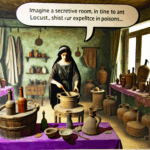
Britannicus, the biological son of Claudius, was a potential rival to Nero. Here the sources are more consistent: they describe Nero arranging a public poisoning at a banquet, reportedly after an initial attempt failed or acted too slowly. Tacitus and Suetonius both place Locusta at the center of this act—providing or refining the poison—after Nero sought a method that would work quickly and decisively.
Key details emphasized in the ancient narratives include:
- Testing and adjustment: Locusta is portrayed as calibrating the poison’s effects, reflecting a Roman belief that toxins could be engineered for timing and plausibility.
- Public theater: Britannicus’ collapse at a banquet is presented as a chilling demonstration of imperial power—death delivered in plain sight, then explained away.
- Political outcome: With Britannicus gone, Nero faced fewer dynastic threats, strengthening his position early in his reign.
Whether every dramatic detail is accurate is debated, but the broader implication is clear: Roman writers depict the imperial court as a place where private violence served public ambition.
Chapter 3: Reward, “Training,” and the Fall After Nero
Locusta’s notoriety grows because she was not merely tolerated—she was allegedly rewarded. Suetonius reports that Nero granted her favors and protection, and later traditions describe her receiving property and even pupils. The idea that an emperor would sponsor a poisoner underscores what Roman historians wanted readers to fear: a state where crime becomes policy when it benefits the ruler.
After Nero’s death in 68 CE, the political climate flipped. Under the new regime, figures associated with Nero became liabilities. Ancient sources state that Emperor Galba ordered punishments for symbols of Neronian excess; Locusta is typically listed among those executed. The exact circumstances are not fully documented, but the narrative function is consistent: the new order publicly condemns what the old order used in secret.
Locusta’s long-term legacy is therefore twofold:
- As a historical person, she represents the shadow economy of expertise—people with specialized skills navigating elite patronage.
- As a literary symbol, she embodies Roman anxieties about moral decay, court politics, and the vulnerability of even emperors to invisible threats.
Locusta’s story endures because it sits at the intersection of crime, medicine, and imperial power. Ancient authors portray her as both a technician of death and a product of Nero’s court, where patronage could transform a condemned criminal into a political weapon. The key takeaway is balance: poisoning tales illuminate Roman fears and propaganda, even when the precise details remain difficult to prove.